Jan 07 2010
What is Adullam’s gathering like?
Over the last few years we’ve had a lot of people ask me what our church gathering is like. Many have even asked to fly out to observe. I’ve always encouraged people not to waste the money because I say it’s just a church gathering but deep down I’ve known that there’s still something that people pick up on that may be a tad unique. Without being self-serving or self-effacing, I was simply tried to avoid the conversation until today. A missionary came by last week and sent me his observations, so I thought I’d just let you hear his thoughts instead of trying to explain it myself.
Observations on Adullam Community Gathering
Bob Ewell, bob@ewell.com,
Introduction
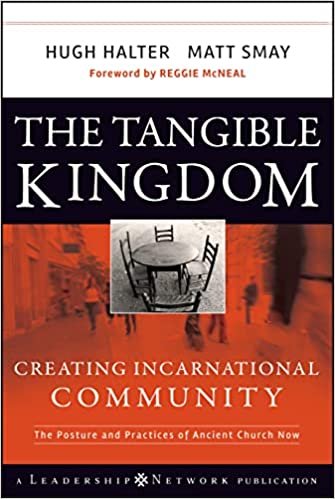
Adullam Community is a group of Christians in Denver who come together to serve the people of Denver. Their story is in Tangible Kingdom by Hugh Halter and Matt Smay, who are the leaders of the community. I read Tangible Kingdom and another church book at the same time. The other recommended a simple approach to church and touted as a main example something like, “You connect with God in worship; you connect with each other in small groups; you then go out to serve.” I remember the stark contrast to Tangible Kingdom which told stories of believers living with and around “sojourners”—people not yet believers. These sojourners would join the believers in some task, sometimes a short-term mission abroad. In the process of serving together, they would form deeper relationships with the believers. Then they would come to faith. It was the exact opposite order of the traditional approach. So the emphasis of Adullam is well-away from the Sunday gathering. In fact, when I told Hugh we might be coming up to visit, he said, “You can visit, but you won’t get the full flavor of Adullam that way.” Again, this is a stark contrast to what most churches would say—“Come on Sunday and check us out!”
So the question is, how does a community like Adullam do Sunday mornings?
Arrive and Mill-around (9:45 – 10:15)
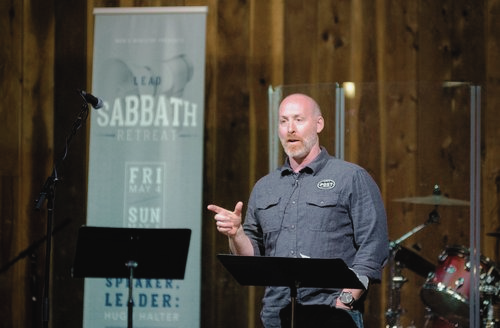
The advertised start time was 9:45a. Hugh told me that if we arrived then, we would be among the first. We arrived at 9:55. Hugh was greeting people at the door, and folks were arriving. We came in and made our way to the coffee area, then just milled around with others. There were no official “greeters,” but we did not feel like outsiders. I don’t know why that was. The operation had the appearance of a large Sunday School class in a mega-church, but when one enters a Sunday School class, in the words of a pastor friend, it feels like a high school reunion—not yours. Again, at Adullam we did not feel like outsiders. There were 8-seat round tables and 4-seat round tables, and a few rows of chairs at the back. We selected a table with open seats and engaged in conversation with the couple seated there. Just before about 10:15, Hugh spoke into the stand-up mike and said we would start in a minute. At 10:15, he welcomed us and said a little something about the theme for the year—being part of the people of God. I did not see anyone come in after 10:15.
Singing/communion meditation/communion (10:15 – 10:45)
Singing was led by one man with a guitar, using the stand-up mike. Songs were singable, meaningful, and there was no attempt to be “edgy” or hype us up. I surveyed the equipment: one stand-up mike (Hugh later used a wireless), one soundboard, computer, projector, screen. Very simple. Then Matt Smay (apparently—no one introduced himself) shared some observations from Hebrews 13 and invited people to the communion table. The table was set up off to one side with two loaves of bread with bowls of juice. People went by families and after they took the bread and juice (by intinction), most went off to one side to pray together. No big deal was made about the elements being “consecrated;” they were just there. The informal approach also solved the problem of what if someone doesn’t want to partake. If you want to partake, go. If not, stay at your table—no one will know the difference either way.
Lecture (10:45 – 11:15)
The sermon consisted of Hugh’s reading all of Ephesians 2 (handouts with complete text were at the tables) and making comments every few verses. All comments were in everyday language, theologically accurate without sounding so. Sensitive to “sojourners” while providing plenty of “meat” for the mature. Lots of specific application. Like “Sin is not just doing stuff you shouldn’t do. It’s not doing stuff you should do. For example, after this gathering, you could go serve someone in some way—or, you could go home and watch football.”
Group processing and benediction (11:15 – 11:45)
After the sermon, Hugh put up a white board on a table (held by a volunteer!) and led a discussion on what it meant that Jesus came “that they might have life and have it more abundantly.” People suggested concepts, and Hugh wrote them on the board. In most cases, he expounded on each one, usually tying it to some scripture. In a subtle way, he demonstrated that the scripture really is our guide for life and that he knew it well. He said he went a little long.
Mill-around and depart (11:45 – 12:15 or longer)
Few seemed in hurry to leave.
Other Observations
Folks were encouraged to come back over the next few weeks, and they would talk about some issues around the structure of their community. Hugh also referred to structure earlier. The impression I got was something like, “We have a structure and a way of doing business, and we want you to know what that is.” I don’t know if there are members of the leadership team other than Hugh and Matt. I got the impression, however, that there was less emphasis on supposedly “lay leadership” than on, “Your leaders have a plan. Here it is.” [I strongly agree with this approach. I don’t like pastors who talk about lay leadership while manipulating people to do what they’ve already decided. And if we let unqualified lay leaders set the direction for the church, it’s likely to go in the wrong direction.]
I’m reflecting now on the fact that I didn’t feel like an outsider even though there was no real overt accommodation to visitors. For example, there was no explanation of communion (that I recall) and no one at the mike introduced themselves. It’s like, “This is a gathering of our community, and you’re welcome to sit in on it.”
Overall, it’s hard to capture in words what we experienced at the Adullam gathering. It was certainly the best Sunday morning experience we’ve had recently, maybe ever. It felt real. There wasn’t an overt attempt to load up the time with too many “elements” of a “service.” The word “service” does not seem to be used. It’s a gathering that includes an informal time and a more formal time. The formal time was not a production, and that lack of “production” felt good. As I recall, in Tangible Kingdom, Hugh says he gives about two hours’ thought to the Sunday gathering. Why not? Why would it need more than that?